
To make informed siting decisions, data center developers need to know the locations and details of fiber optic lines. Data center developers and energy developers may also want to know the locations and details of both operational and planned data centers.
Fiber Optic & Data Center information is an add-on feature. Please contact your Transect Customer Success Manager for more information.
In this article, we’ll review:
- What’s Included
- Frequently Asked Questions
What’s Included— Fiber Optic Lines
This dataset provides the locations and details of approximately 500,000 miles of fiber optic cables, including their type, operational status, ownership information, and placement. This includes:
- Name: Generally the shortened version of the line owner, not a unique name. This is the label that appears on the Map.
- Type: Indicates whether the line is long-haul backbone, regional backbone, metro backbone, or metro last-mile.
- Service type: Indicates whether the line is lit, dark, or a mix of lit and dark.
- Status: Indicates whether the line is Operational, Abandoned, Under Development, or Idle.
- Ownership:
- The current line operator and line owner (which may be the same or different)
- The previous owner
- Whether the line is owned, leased, or has an Indefeasible Right of Use (IRU)
- Placement: Whether the line is overhead or underground.
- Length: The length of the line in miles.
Please note that these attributes may not be available for every line.
To view this layer in the Map, check the box next to the Fiber Optic Cables layer: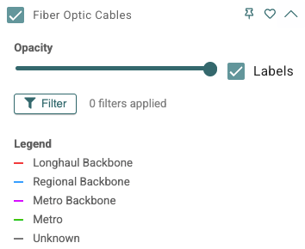
Additionally, you can select  to view fiber lines based on their Placement, Operator, Owner, Service Type, Status, or Type.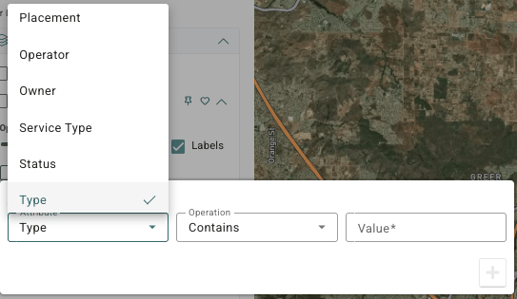
When setting the Operation to "Is", some Attributes will populate a dropdown menu with filter options: 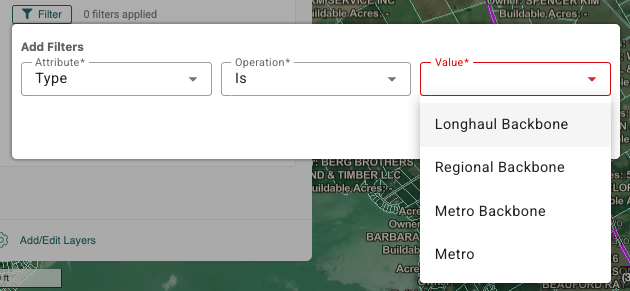
Filtering Parcels by Proximity to Fiber Lines
Within the Map, you can use the Parcel Filter to locate parcels based on selectable criteria. To use a Fiber Optic line as your search, you can follow the steps below:
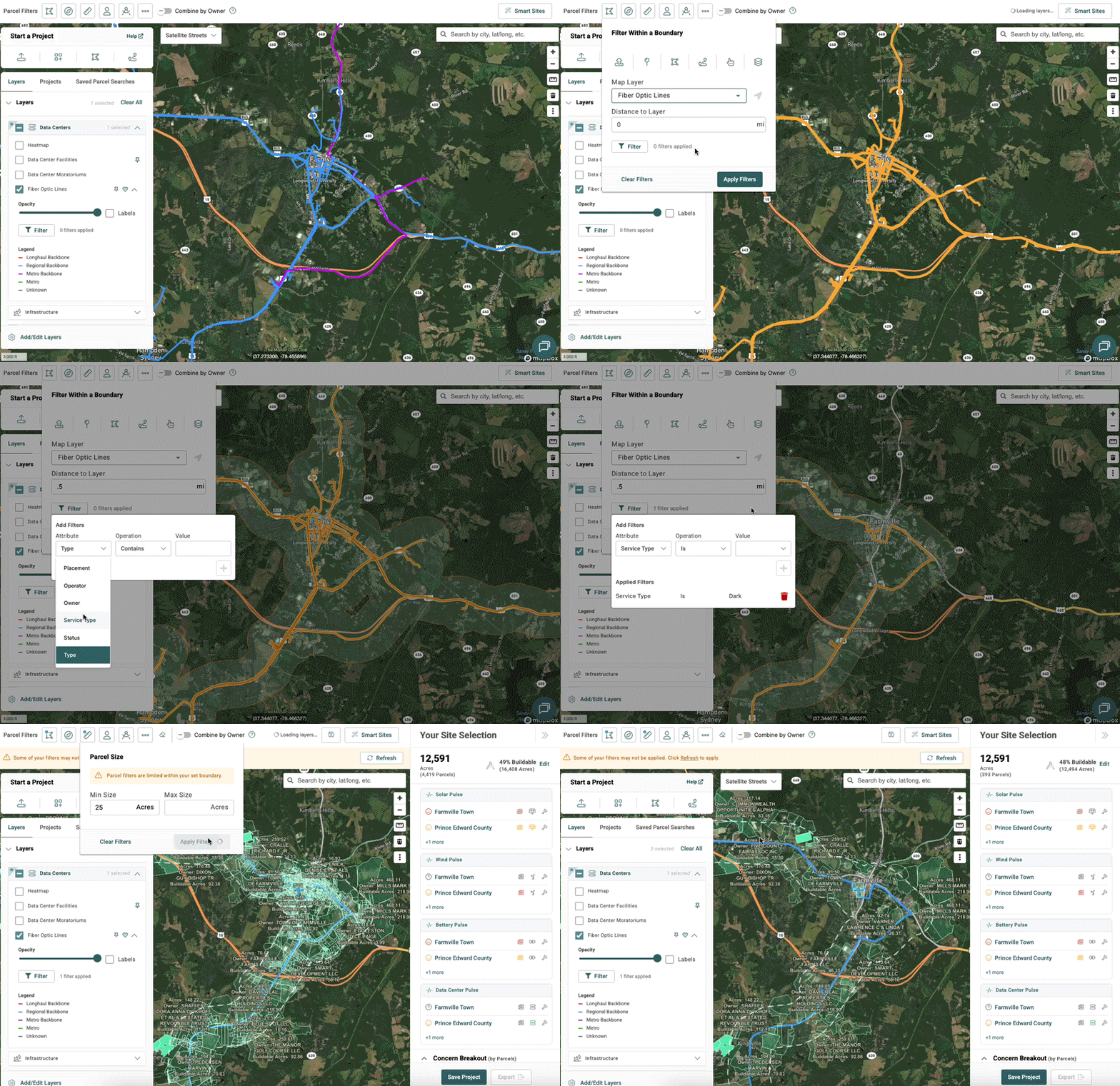
- Navigate to the Map from the top of any page.
- In the "Parcel Filters" toolbar, select Boundary
 and then Map Layers
  .
. - Within the "Choose a Layer' dropdown, select Fiber Optic Cables and specify the search area around the layer (in miles).
- Optionally, you can select
 to refine your search by:
- Placement
- Operator
- Owner
- Service Type
- Status
- Type
- When finished, select Apply Filters.
What's Included—Data Centers
This dataset provides the locations and details of approximately 3,000 data centers across North America. This layer may include the following attributes:
- Name: The common name of the facility.
- Operator & Owner: The current operator and owner (may be the same).
- Status: Operational, Under Development, etc.
- Total Area (sq ft): The size of the facility.
- Total Power (MW): How much energy the facility draws from the grid.
- Available Services: Internet Exchange, Cloud Node, Colocation Facility, and DR/BC (Disaster Recovery/Business Continuity) services.
- Certifications: Security and regulatory compliance certifications (e.g., HIPAA, SOC, PCI).
Please note that these attributes may not be available for every data center.
To view this layer in the Map, check the box next to the Data Centers layer: 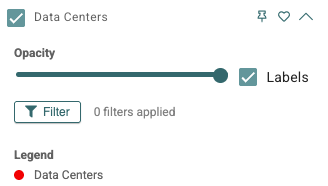
Additionally, you can select to view data centers based on their Name, Operator, Owner, Status, or Total Power (MW).
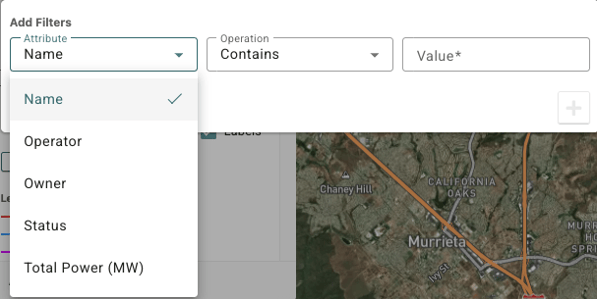
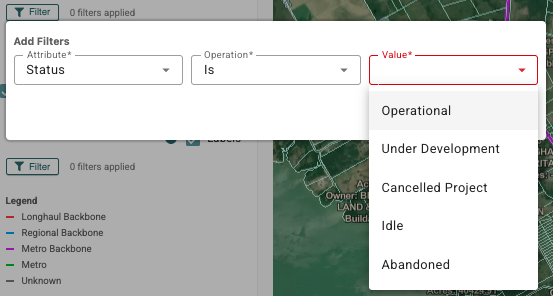
To filter by "Status", we recommend setting the Operation to "Is" to populate a dropdown of available options:
Frequently Asked Questions
Fiber Optic Lines
- How accurate are the line locations?
Typically within a few meters. You should contact the line operator to confirm the precise location. - Where does this data come from?
The data is provided by the line operators (carriers). - Is coverage “complete” and always up to date?
The dataset covers the 48 lower US states and is updated on a rolling basis. However, there may be update delays, as new lines are deployed all the time and frequently change owners and status. If you are aware of missing lines or inaccurate data, please notify support@transect.com. - How often is the data updated?
This data is planned for an update every two months. - Can fiber data be exported?
No, this is not part of the agreement with the data provider. - Does any fiber data appear in reports?
No, but we’ll look to include this in future updates.
Data Centers
- Why do you sometimes see multiple point locations on the map for the same building?
This can happen if the data center changed ownership or name and there are separate records. This can also happen if the data center was built in phases, resulting in multiple records with different names in the same or adjacent buildings. - Where does this data come from?
This data comes from facility operators, news articles, permit filings, and other sources. - Is coverage “complete” and always up to date? How often is the data updated?
This coverage is continuously under development and updates are currently scheduled for once per month. - What if a data center isn’t listed?
If you notice that a data center is missing, please contact support@transect.com so we can investigate.