
For purposes of federal tax incentives under the Inflation Reduction Act, an energy community is a geographic area where projects may be eligible for additional tax credit incentives if specific criteria are met. These areas include brownfield sites, statistical areas with fossil fuel employment or revenue and higher-than-average unemployment, and coal mine closure areas. Transect helps developers identify potential sites within these communities, accelerating the clean energy transition and revitalizing local economies.
In this article, we’ll review the:
Energy Community Map Layers
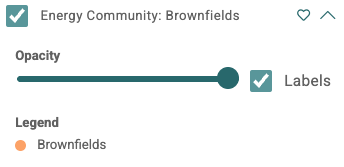
Brownfields
Brownfields are typically former industrial or commercial sites where the presence or potential presence of contamination may complicate redevelopment. While some brownfield sites may qualify for Energy Community incentives, there is no comprehensive IRS or Treasury dataset identifying all qualifying brownfield Energy Communities. Many qualifying sites may not appear in public datasets and are instead identified through site-specific investigation (e.g., environmental site assessments). As a result, this layer should be used as a screening indicator only, and eligibility is determined based on site-specific conditions.
The following layer provides Brownfield locations:
Coal Communities
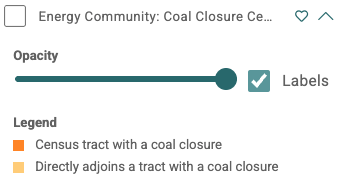
The Coal Closure category of Energy Communities includes census tracts and adjoining tracts associated with coal mine closures and coal-fired electric generating unit retirements, as defined by the U.S. Department of the Treasury and IRS. These areas are often associated with historical coal industry activity and may be prioritized for redevelopment and investment.
The following layer provides Coal Closure Census Tracts:
- Energy Community: Coal Closure Census Tracts: This layer identifies U.S. census tracts and adjoining tracts associated with coal mine closures since 1999 or coal-fired electric generating unit retirements since 2009, based on datasets published by the U.S. Department of the Treasury and IRS.
MSA and Non-MSA Energy Communities
MSA stands for Metropolitan Statistical Area, which typically refers to a large city and its surrounding suburbs. Non-MSA areas are rural or suburban regions that don't meet the criteria for a metropolitan area. In the context of energy communities, these terms categorize regions based on population density and economic characteristics.
Both MSA and non-MSA areas can qualify as energy communities if they meet specific criteria related to fossil fuel employment and unemployment rates. The IRA defines eligibility based on thresholds for fossil fuel employment or local tax revenue, combined with unemployment at or above the national average, as implemented through Treasury/IRS datasets. The following layer provides MSA and Non-MSA Energy Community locations: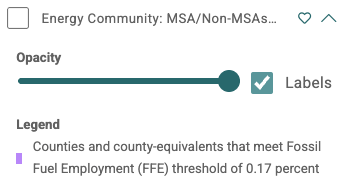
Low-Income Bonus Credits
The Low-Income Bonus Credits are separate from Energy Community eligibility under the Inflation Reduction Act. While Energy Community bonuses are automatically determined based on project location, the Low-Income Communities Bonus Credit is a separate, application-based program that applies only to certain qualifying solar and wind projects (generally ≤5 MW) and requires an application and allocation. Eligibility is determined based on one of four categories defined by the IRS:
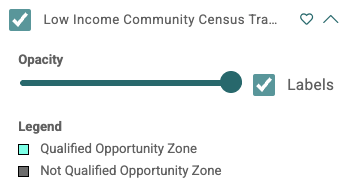
- Low-Income Community Census Tracts: This layer identifies census tracts that meet the definition of a low-income community, where the poverty rate is at least 20% or median family income does not exceed 80% of the applicable statewide or metropolitan area median, consistent with §45D(e). Projects located within these tracts may qualify under Category 1 of the Low-Income Communities Bonus Credit, subject to program requirements. You can reference the layer below for this information:
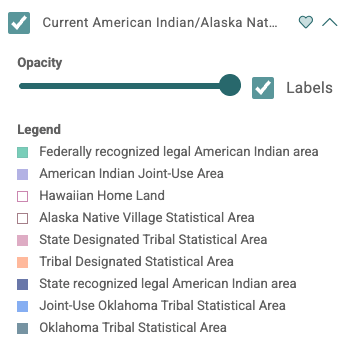
- Tribal Lands: This layer identifies areas that may correspond to Indian land, as defined in §2601(2) of the Energy Policy Act of 1992, based on available spatial datasets, which may not fully align with the statutory definition in all cases. You can reference this layer for Native lands/territories:
- Qualified Low-Income Residential Building Project: A project qualifies if it is installed on a residential rental building participating in an affordable housing program and provides financial benefits of the electricity produced to building occupants.
- Qualified Low-Income Economic Benefit Project: A project qualifies if at least 50% of the financial benefits of the electricity produced are provided to households meeting specified low-income thresholds.
Important Considerations
- Energy Community eligibility is determined using datasets that are periodically updated by the U.S. Department of the Treasury and IRS, so qualifying areas may change over time.
- Identification of Energy Community overlap is based on a project’s area of interest (AOI) and does not confirm eligibility for tax credits. Final eligibility depends on project-specific factors, including whether at least 50% of the project’s nameplate capacity (or, for projects without nameplate capacity, 50% of square footage) is located within a qualifying Energy Community, as well as other legal and timing requirements.
- Energy Community datasets are derived from federal sources and may include approximations where precise location data is unavailable.
- Statistical Area Energy Community eligibility is determined using datasets published by the U.S. Department of the Treasury and IRS, which apply criteria related to fossil fuel employment or local tax revenue, along with unemployment thresholds.
- In New England, statistical areas are defined using city and town boundaries rather than counties. As a result, county-level data is used as an approximation and may not perfectly align with statistical area designations.